Eight Laws of Change – Coast to Coast
In the first half, researcher in non-local consciousness and futurist Stephan Schwartz spoke about his research into social transformation and how individuals and small groups can change the course of history. He developed eight laws of change that all promote well-being, some taken from the philosophy of the Quakers. These include:
- The individuals and the group must share a common intention.
- Though they have goals, the group shouldn’t have cherished outcomes.
- The individuals and the group must accept that their goal may not be reached in their lifetime, and be OK with this.
- The group members must accept that they may not get credit for their efforts.
- Each person in the group must enjoy fundamental equality, even while allowing for hierarchical roles.
- The individuals must make their private selves consistent with their public postures.
Schwartz discovered that change achieved through violent means tends to have a shorter lifespan than transformations arrived at by consensus or peaceful solutions (like Gandhi). Benjamin Franklin was one of the earliest Americans to practice these type of laws, he said, such as through his creation of micro-lending, and private philanthropy. “When you support well-being,” Schwartz remarked, “you get a social policy which is more efficient, more effective, easier to implement, more productive…and much much cheaper.” Currently, we are in a civilization-threatening crisis, he continued, and if we don’t focus on empowering integrity and connecting with something greater than ourselves, future generations could be in serious trouble.
Improve Your Life With Meditation
Leading health specialist, author, and radio show host, Nancy Gibbons Addison talks with Stephan A Schwartz, a renowned meditation expert, among other scholarly accomplishments. He discusses the ways to implement a realistic and effective meditation in your daily life which can improve your sleep, eating habits, immune system, mental abilities, relationships, physical health, among other things. Incredible benefits anyone can do, anywhere for free.
The Spark: Episode 057 Changing The World with Stephan A. Schwartz
So, you want to change the world? Stephan A. Schwartz, a social change agent and internationally known researcher in the field of extraordinary human functioning, will show you how to do just that. As a scientist, author, and researcher, Stephan has been a major player in leading change through the civil rights movement, in the military transformation of the 1970s, and was also a member of the Secretary of Defense/MIT Discussion Group on Innovation, Technology, and the Future. Most recently, his award-winning book, The 8 Laws of Change, presents two decades of research on how an individual can become an agent of social change. Our conversation with Stephan will empower you to discover your own inner ability to bring more compassion, well-being and positive change to yourself and to our planet.
End of the Road March 2019 Interview
Ep. 65 Stephan A. Schwartz: Non-Local Consciousness/The 8 Laws of Change
In this podcast, we discuss his book “The 8 Laws of Change,” winner of the Nautilus Book Award for Social Transformation, which looks at how notable individuals like Gandhi, Rev. Martin Luther King Jr., and Benjamin Franklin found ways to enact lasting change. Schwartz also draws from his own experience with the Civil Rights Movement, the U.S. Navy, and work at Esalen Institute. We also discuss how the diverse fields of medicine, neuroscience, biology and quantum physics describe how these laws of change can be adopted by any individual.
March 24th Interview on 21st Century Radio
We discuss:
Climate Change; White Supremacy/Nationalism; Wealth Inequality; and Stephan’s new novels on consciousness: Awakening: A Novel of Aliens and Consciousness, Greenwood Press, 2017; and The Vision: A Novel of Time and Consciousness, Greenwood Press, 2018.
Supernatural Realm 2019-03-12 Special Guest Stephan Schwartz
Tuesday 3/12/2019 @ 7-9 Pm EST. We spoke with Stephan Schwartz – Effects of Cultural and Social Trends, The 8 Laws Of Change, Non-Local Consciousness, Remote viewing, and related topics, on The Supernatural Realm live on WCET. FM
www.latenightinthemidlands.com
on talk stream live and the paranormal radio app
Midnight in the Desert with Dave Schrader
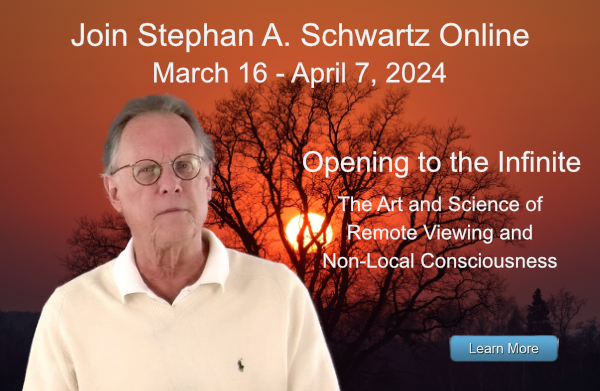
Stephan Schwartz discusses the application and utilization of Remote Viewing and the capabilities to reexamine history and creating new investigative protocols.
The Alexandria Project with Stephen A. Schwartz
Path 11 Podcast 191 The Alexandria Project with Stephen A. Schwartz
The Alexandria Project:
The Alexandria Project is the true story of how researchers from five universities and organizations went to Egypt to put the claims of a psychic ability known as Remote Viewing to the ultimate test. Was it possible, under rigorously controlled conditions, for some part of the human mind to locate and describe ancient sites known to exist, but now lost to history? How good was Remote Viewing when compared with electronic remote sensing technologies traditionally used by archaeologists?
Stephan A. Schwartz, Part 2, Visionary Scientists with Gayle H Kimball
Stephen Schwartz, Ph.D., discusses his book “The 8 laws of Change,” his novels, the core elements of religion, and the core beliefs of the revolution in consciousness.
Nemoseen Media

Nemoseen Media offers you print and electronic media concerning extraordinary human functioning, particularly Remote Viewing. All its materials are based on the latest laboratory research, yet they are presented in a way that is easily understood and can be used by everyone.

Schwartzreport is an entirely fact-based daily publication in favor of the earth, the inter-connectedness and interdependence of all life, democracy, equality for all, liberty, and things that are life-affirming. It also warns readers about actions, events, and trends that threaten those values. Our country now stands at a crossroads, indeed, the world stands at a crossroads where those values are very much at risk and it is up to each of us who care about fostering wellbeing to do what we can to defend those principles. Schwartzreport is designed to give you reliable information to help you in that.

The Gold Standard Course

Meditation for Modern Minds